


Your shopping cart is empty!
Pumpkin "Melonowa Zolta"
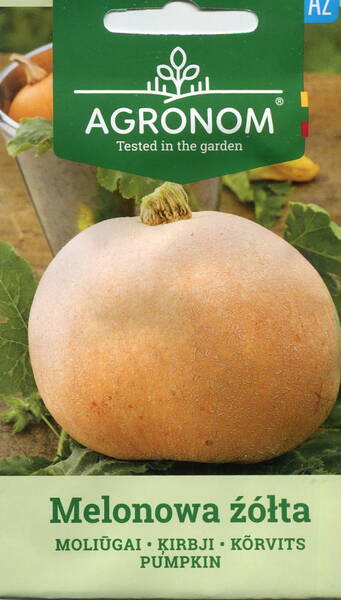

Cucurbita maxima Duchesne
0.80€
Ex Tax: 0.65€
Ex Tax: 0.65€
Pumpkin "Melonowa Zolta".
A productive mid-early variety. Vegetation period: 88 days. Fruits weigh about 20–25 kg. Medium-thick yellow flesh with a pleasant taste.
Grows best in wind-sheltered sandy or light loamy soils.
Variety value: easy to grow, abundant fruiting, excellent taste, outstanding keeping quality. Recommended for dietary and children’s meals, juices, fresh salads, and cooking.
1.0 g = approx. 2–5 seeds.
A productive mid-early variety. Vegetation period: 88 days. Fruits weigh about 20–25 kg. Medium-thick yellow flesh with a pleasant taste.
Grows best in wind-sheltered sandy or light loamy soils.
Variety value: easy to grow, abundant fruiting, excellent taste, outstanding keeping quality. Recommended for dietary and children’s meals, juices, fresh salads, and cooking.
1.0 g = approx. 2–5 seeds.
Growing.
Pumpkin has similar outdoor requirements to cucumber, but is more tolerant of adverse conditions, especially temperature, and is well suited for open-field growing. Pollen germination and growth occur at lower temperatures than in cucumber (+14+15°C) and melon (+18°C). Warm weather and good moisture support growth, and pumpkin can go longer without irrigation than cucumber. Because it is sensitive to wind, pumpkin is often recommended to be grown between corn plants.
Pumpkin prefers loose, humus-rich soil and responds well to organic fertilizers.
It does not tolerate repeated cultivation after other cucurbits, which should also be considered when growing on compost heaps.
Harvest can be brought forward by raising seedlings in greenhouses. Sow 2–3 seeds in 10 cm pots, 2–3 cm deep. Seeds germinate at +15+20°C. Then maintain +18/+14°C (day/night).
After 3 weeks, seedlings have 2 leaves and are ready for planting out. Harden plants to improve tolerance to cool weather. Plant in mid-May after the risk of night frosts has passed. Plant density: bush types 0.5–1 plant per 1 m²; trailing types about 0.3 plant per 1 m².
Growing on mulching film works well; in this case, direct sowing is possible.
Care mainly includes repeated shallow loosening. Toward the end of the season, weed control may be needed (hand weeding). No special pruning is required.
Diseases and pests are usually of secondary importance. Noticeable damage is mainly caused by viral diseases (control of vectors is needed) and late-autumn powdery mildew.
Harvest and storage.
Harvest before the first frosts once fully ripe. Leave a stalk of about 10 cm. Depending on productivity (on average 4–5 fruits per plant), harvest heavier or lighter single fruits. Individual pumpkins can reach 120 kg, and yields can exceed 1000 c/ha.
Pumpkins can be stored for several weeks to several months. Optimal temperature for the first two weeks is +24+30°C, when after-ripening occurs and the rind hardens. After that, reduce storage temperature to +10+13°C.
Bot.: Cucurbita maxima Duchesne
* Training trailing pumpkin varieties.
At the 3–5 leaf stage, the plant forms flower buds and side shoots. While vines are still short and not tangled, gently guide their growth in one direction. You can even pin a vine to the soil with a wooden fork (loosely, without squeezing).
It is best to keep 2–4 vines (no more). Remove the rest and dust the cut surface with ash.
When the remaining vines reach 1.0–1.5 m, pinch them to stimulate side shoots, where most fruits will form.
To grow larger fruits, leave 1–2 fruit sets per vine (sometimes 3–4) and remove any extra 1–2 once development is normal.
Throughout the season, remove new side shoots that do not form flowers.
You can also remove all vegetative axillary shoots while they are under 5 cm long.
In August, finalize the crop by leaving the desired number of fruits (2–4 per plant).
Pick ripe fruits before cold weather and store in a dry, warm place.